

Slimane Azem, a voice from Kabylie in the memory of Longwy
On Friday 18 September, at the Parc des Récollets, the songs of Slimane Azem echoed through a city that was once home to his years as a worker. Between the memory of exile, working-class history and the transmission of Kabyle culture, Longwy has reclaimed a figure who now belongs to its own history.
There are tributes that take place in silence. And then there are those where memory returns through music.
On this Friday 18 September, the voice of Slimane Azem mingled with conversations, memories and the tunes of the Fanfare du Soleil. Around the lane that already bears his name, residents, elected officials, CBF representatives and many members of the Kabyle community gathered to pay tribute to a man who was at once poet, singer, exile and… steelworker in the Longwy basin.
There was something singular about hearing his songs here. Because before becoming one of the great voices of Kabyle song, Slimane Azem had known the factories of Longwy. The dust, the work, the blast furnaces, the long working days. And exile.
Born in Kabylie in 1918, Slimane Azem arrived in France in 1937. He was 19 at the time. Like many young men of his generation, he left his homeland to come and work in France. His path led him in particular to the Longwy basin, where he worked for nearly two years in a steel mill.
Decades later, his name is still there. On a lane. On plaques. In people’s memories. And above all in the songs.
Because Slimane Azem sang about what many immigrants know intimately: being torn from one’s homeland and family, exile, hard labour, loneliness, the country one has left and continues to think about.
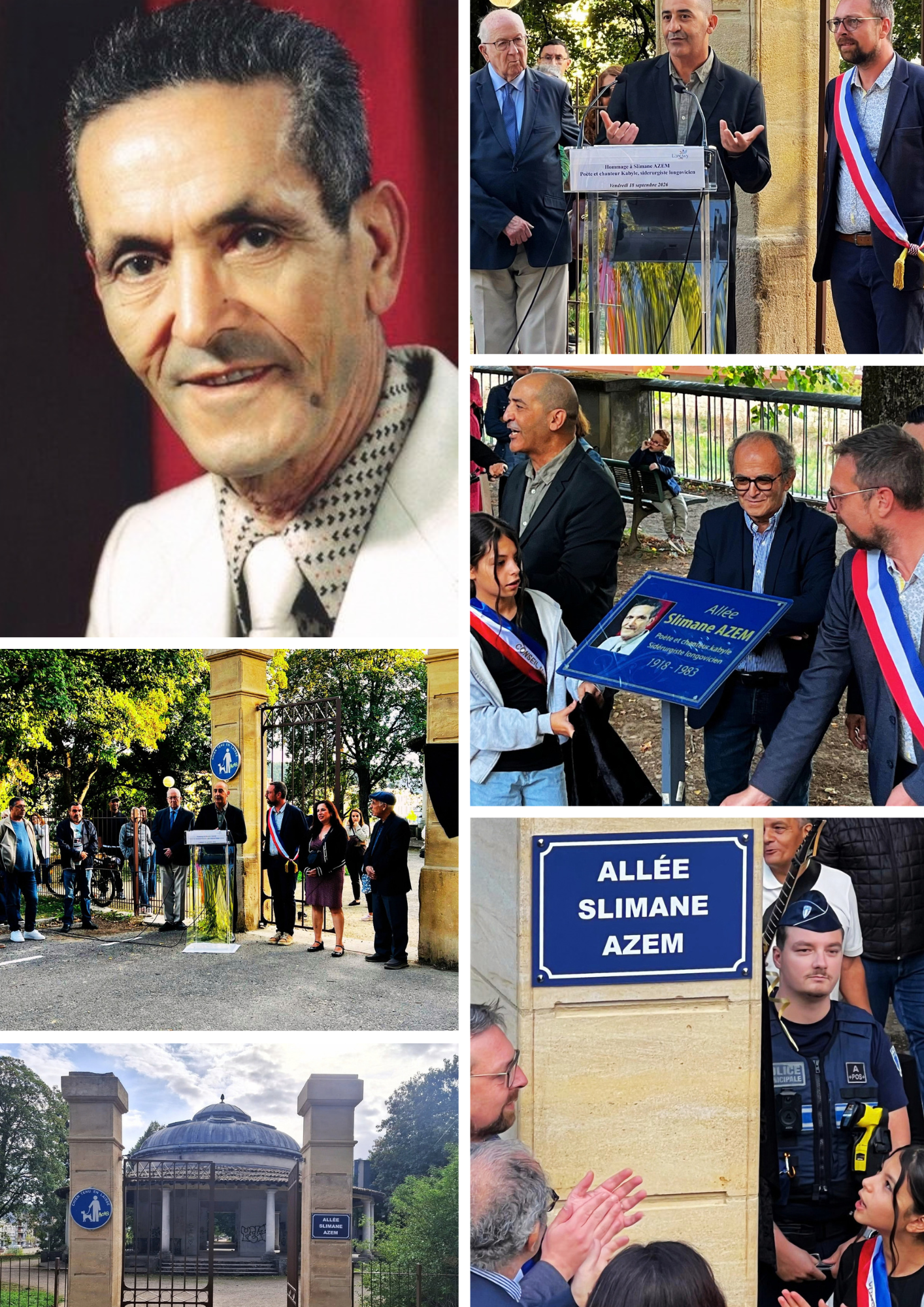 “Slimane Azem was not just a singer, he was a voice,” recalled the mayor of Longwy, Vincent Hamen, during the ceremony. A voice carrying “exile, nostalgia for the homeland, attachment to language, to memory and to one’s roots.”
That sentence perhaps sums up, better than any biography, what took place that Friday.
Three plaques, three traces in the town
A first plaque is unveiled. Then the Fanfare du Soleil leads the participants through the park. Slimane Azem’s songs ring out once more.
A second plaque appears. A minute of silence is observed.
Then a third plaque, marking Allée Slimane Azem, is officially unveiled.
Three simple gestures to further inscribe his name in the town.
Three traces in a park where passers-by will now be able to come across his name without necessarily knowing his story.
And perhaps that is where transmission truly begins.
A child who asks: “Who was Slimane Azem?”
A parent who tells the story. A song someone plays for them. A story passed from one generation to the next.
Among those who helped bring this tribute to life, Jean-Paul Durieux holds a special place. A former member of parliament and mayor of Longwy, and general councillor of Meurthe-et-Moselle, he recalled that the artist had lived in the region for several years and worked, like many other residents, in the factories. For him, Slimane Azem had become “a brother, a comrade.”.
War, rifts and silences
To understand this body of work, one must also look back at the troubled history of Algeria.
The Algerian War profoundly upset societies and families. In Kabylie, the extremely violent clashes between the FLN and the MNA, the war waged by the French army, and the manipulation of the harkis shattered long-standing solidarities and caused deep rifts and destructive divisions within villages and families.
The traumas were never dealt with!
The talk given at the town hall by Youcef Nacib, Slimane Azem’s biographer, made it possible to place the artist’s life within this complex history, one that weakened Kabyle society, which lost so many of its women and men.
Slimane Azem would never see his homeland again. His songs would be absent from Algerian airwaves. But a voice banned from the airwaves is not necessarily a voice that disappears. It travels another way. In families. In cafés. At gatherings. In communities settled in France. On cassettes people share with one another. Then on new formats. Slimane Azem’s voice thus crosses decades and borders. It accompanies those who left Kabylie, but also their children and grandchildren. Kabylie then becomes a land of memory. An inner landscape.
Exile turns memory into song.
And the song turns memory into collective memory — that of the Kabyle people.