

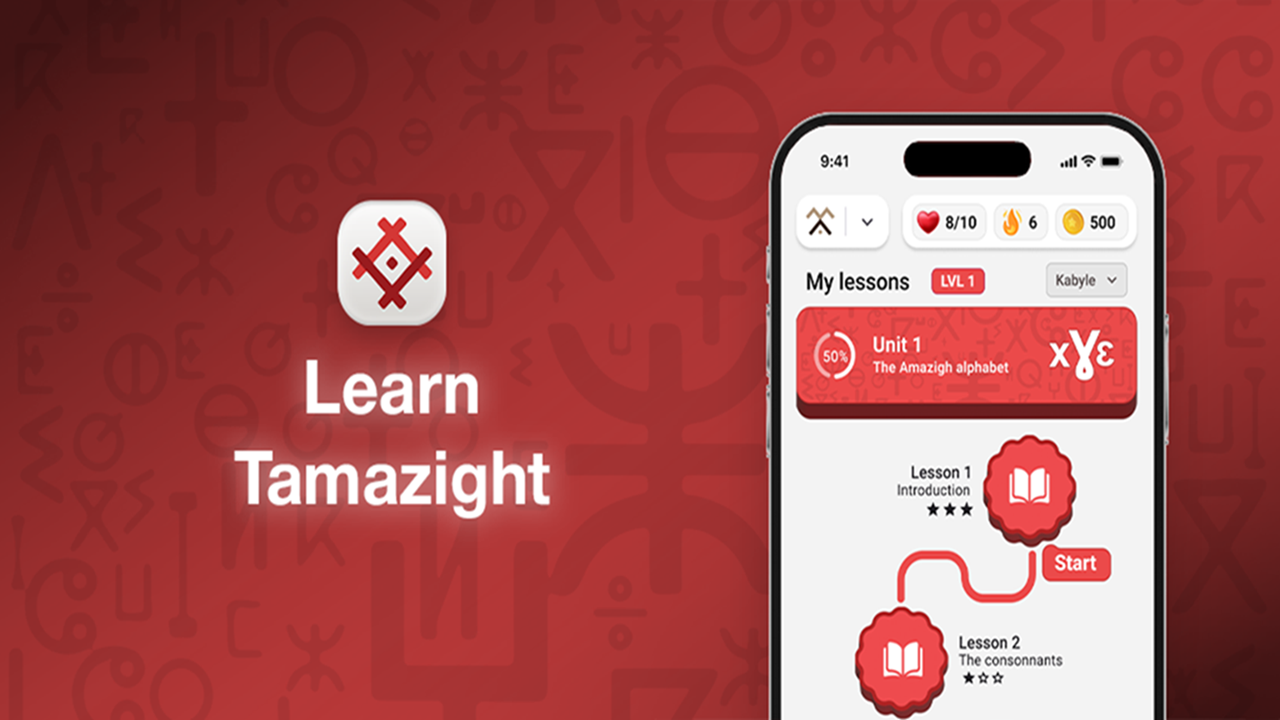
 Presentation of the Tussna app by its developer
Tussna: a 21-year-old student creates a “Duolingo-like” for Amazigh languages
Learning Tamazight has long meant hunting for scattered resources. Mohamed Kabouk, a 21-year-old computer science student, is tackling this gap with Tussna, his first app, which aims to do for Amazigh languages what “Duolingo-like” did for the world’s major languages.
A developer who is also a speaker
Mohamed is Amazigh, from the Shilha community, and his mother tongue is Tachelhit. Tussna grew out of a simple observation: there is a real need for a well-designed learning app for the Imazighen. He is developing it while continuing his computer science studies.
Kabyle first, five more languages planned
The first language supported is Taqbaylit (Kabyle). One of the app’s designers is Kabyle and writes the content himself. It is then reviewed and critiqued by the community, which acts as a validation step.
The plan is broader. Tussna intends to expand to five more languages, with Tachelhit as the next step, Mohamed’s own language. Beyond that, he hopes to add a new Amazigh language every month.
The app is currently aimed at an English-speaking audience, and the French and Spanish versions are under development.
Latin Amazigh script, no Tifinagh yet
Tussna currently teaches theLatin Amazigh script. Tifinagh is not supported for the moment. Mohamed believes the Latin script is underrated and deserves to be used more.
As for spelling, the app follows the conventions of Kabyle speakers as closely as possible. The vocabulary mixes neologisms and borrowed words, which Mohamed regards as valuable features of a living language.
Designed for the diaspora
The app is aimed mainly at the diaspora. According to Mohamed, the Imazighen form a large community around the world that deserves apps, content and resources designed for it.
Technology: Flutter, built for offline use
Tussna is developed with Dart and Flutter, chosen so that it can run on both Android and iOS. It works well offline and in areas with poor connectivity, which matters for users whose Internet access is unreliable.
Free today, optional subscription tomorrow
The app is completely free for now. In the future, it is to be funded by an optional subscription.
What comes next
The next internal step is a lesson engine, a tool that lets the team quickly create new lessons. This would make it much easier to enrich the content and add new languages at the planned pace.
Conclusion
Tussna is still young: one language, one script, a small team. But it has a clear roadmap and a founder who speaks one of the languages it wants to serve. If the lesson engine delivers, a new language every month could make it an important tool for learning Amazigh languages worldwide.